
Yellow chicken and potatoes are extremely popular in Israel. You can find them made in homes, sold hot in stores, and even in children's hot lunches. Just add green beans as a side and it is ready to serve.
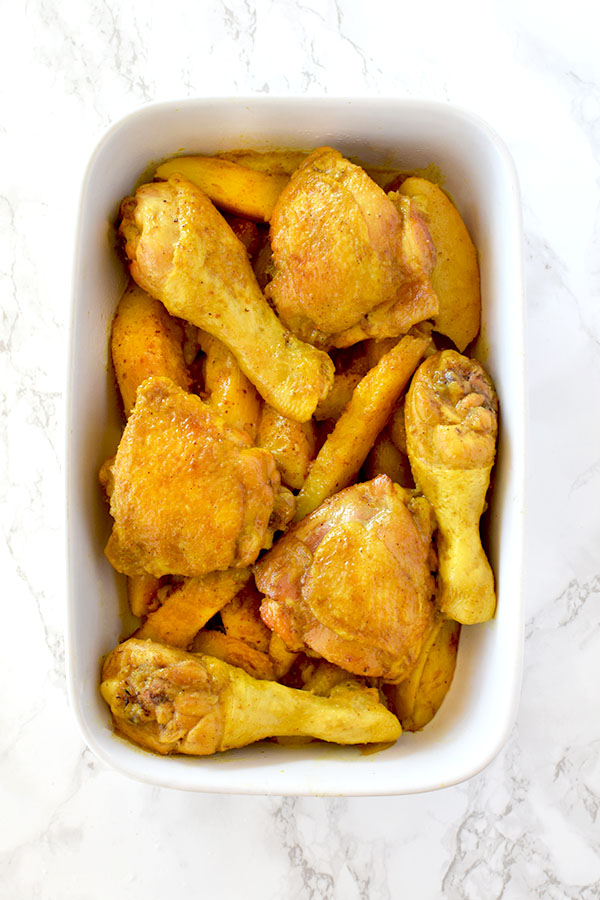
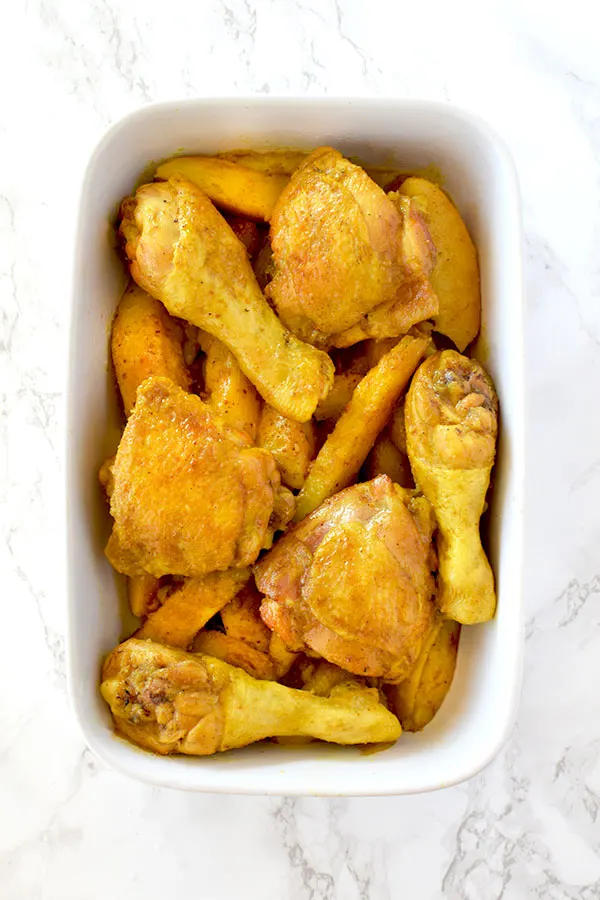
Israeli yellow chicken is one of my family's favorites. This is because it is not only tasty but also easy and relatively quick to make.
I especially like that by making this one recipe, you have two thirds of your meal complete. Like with Israeli paprika chicken and potatoes, all you have to do is add a vegetable and you’re done.
At first, I thought this recipe may have a Yemenite origin because it calls for hawaij. However, after asking my mother’s Yemenite friend, I discovered this wasn’t the case.
Apparently, Yemenite Jews in Israel use the spice so much that it spread into Israeli cuisine.
Hawaij has a great flavor. You can likely find this spice at your local Jewish supermarket or Israeli minimarket.
Make sure to buy hawaij made for soups, not for coffee. If it doesn’t say which it is, you can assume it’s the right one. If you can’t find or don’t want to buy hawaij, you can replace it with more turmeric.
If you like this yellow chicken and potatoes recipe, you may also like my Israeli yellow rice.
You may also like my Moroccan Chicken and Olives or my Greek Lemon Chicken and Potatoes.
Cutting Potatoes
You can cut your potatoes to any shape. However, what is most commonly seen in Israel is a steak fry cut.
Keep in mind though, if the potatoes are too thin, they may start to disintegrate. and i f they are too thick, they will take longer to cook.
IS KOSHER CHICKEN BETTER?
Kosher animals are kept in better conditions than non-kosher animals due to strict kosher health requirements of the animals.
Also, the salting process used as part of the process of making meat kosher is similar to dry brining, and therefore produces a better quality meat.
While I’ve only eaten kosher meat so I cannot compare, I’ve been told by non-Jews who do not keep kosher that they’ve noticed that kosher chicken is of superior quality to cook with.
SHOULD YOU WASH CHICKEN?
According to the USDA, you should not wash meat or poultry, since water can splash bacteria up to 3 feet surrounding your sink.
A study done by Drexel University shows that it is best to move meat and poultry directly from package to pan. The heat from cooking will get rid of any bacteria that may be present.
HOW CAN I CLEAN MY CHICKEN WITHOUT WASHING IT?
If you want to clean your chicken without washing it, wipe it down with a wet paper towel.
Just make sure the paper towel doesn't touch anything else and to toss the paper towel right away.
HOW TO DEFROST CHICKEN
IN THE FRIDGE
Defrosting chicken in the fridge is the most highly recommended.
To do this, place the frozen chicken in a pan and let it thaw. Oftentimes, when chicken thaws, it releases liquids that can leak onto your fridge, so the pan is really helpful.
Chicken typically takes a full day to thaw. Once thawed, it can remain in the refrigerator for a day or two before cooking.
IN COLD WATER
Defrosting chicken in water should take two to three hours.
Submerge your sealed chicken in a pot or bowl full of cold water. Change out the water every 30 minutes or so.
Do not hot use water because it can start cooking your chicken.
Can you cook FROZEN chicken?
According to the USDA, you can cook frozen chicken. It will take 50% longer to cook, but it’s an option.
You should also cook it on a roasting rack or over vegetables so that the heat can circulate around the chicken.
CAN YOU REFREEZE RAW CHICKEN?
According to the USDA, “food thawed in the refrigerator is safe to refreeze without cooking.” However, you do lose quality when refreezing previously defrosted meat.
Every time you defrost meat, it loses moisture as it thaws, which also leads to a loss in flavor. To compensate for this, marinate the chicken to add more flavor and juice.
The USDA also says not to “refreeze any foods left outside the refrigerator longer than 2 hours; 1 hour in temperatures above 90°F.”
SHOULD YOU BRINE?
Brining actually doesn’t do anything to help poultry. In fact, it makes it soggy rather than juicy, with watered-down flavor.
Aromatic brines and stock don’t help with flavor either. This is because the salt pulls water molecules in, leaving most of the flavor behind.
DRY BRINING
A dry brine, on the other hand, loosens up muscle fibers, allowing them to retain more moisture without adding any excess liquid.
Initially, the salt draws moisture out, then it dissolves in this liquid, creating a concentrated brine, which eventually gets reabsorbed. This leads to more intensely flavored results.
An added benefit is that it also requires less space and mess than a water brine. Not to mention the fact that it allows for crispier skin.
CAN YOU DRY BRINE KOSHER chicken?
Food experts are often under the impression that kosher meat and poultry cannot be brined and dry brined.
This is because of the koshering process, which involves salting the meat. However, the process is not nearly as long as the dry brining process, and unlike a dry brine, the poultry is soaked to remove the salt.
So, since the process is different than a dry brine, it is fine and even recommended to dry brine kosher poultry and meat.
How do you dry brine chicken?
Begin by patting the chicken with paper towels. This will help the salt adhere to the chicken.
Grab pinches of kosher salt and sprinkle it over the chicken until the chicken is generously salted and evenly coated.
Place the dry-brined chicken on a rack or a plate and refrigerate it. Refrigerate chicken pieces for at least 1 hour, skinless pieces for 30 minutes to 1 hour or up to about 12 hours, and a whole chicken for 8-24 hours.
Once the waiting period is up, there is no need to rinse off the chicken. Just cook it as usual.
TYPES OF POTATOES
There are generally three types of potatoes: waxy, starchy, and those in between.
WAXY
Waxy potatoes, such as Red Bliss and fingerlings, have a smooth skin and creamy, almost shiny flesh.
Because waxy potatoes are relatively low in starch and high in moisture, they stay intact when they’re cooked.
STARCHY AKA FLOURY
The most common example of starchy potato are russets, A.K.A. Idaho potatoes.
As you may have guessed by their name, they’re higher in starch and lower in moisture than waxy potatoes. They are matte-skinned and fall apart when boiled.
Starchy potatoes are ideal for adding creaminess to puréed soups or providing the airy, whipped texture to a mash. They are also good for roasting and frying.
IN-BETWEEN
These fall somewhere between the waxy and floury, making them the “all-purpose” potatoes. The most commonly known of them are Yukon Golds.
Because they hold their shape when boiled, grated, or fried, and yield to mashing, they’re very versatile.
Adjusting for a Convection Oven
Convection ovens blow the hot air around, producing around 25 to 30 percent more heat.
Since convection ovens produce more heat, you need either lowering the temperature or shortening the cooking time to compensate.
When recipes specify temperatures and cooking times, it’s for conventional ovens, unless specified otherwise.
A simple rule to follow is to lower the temperature by 25ºF or 14ºC when baking cookies and pies, and 50ºF or 28ºC when roasting meat and poultry. Some convection ovens offer separate settings for baking and for roasting.
You can also leave the temperature the same and instead, shorten the cooking time by 25 percent. For example, if your recipe calls for 60 minutes in the oven, check the food after 45 minutes instead.
However, keep in mind, some convection ovens actually make a heat adjustment for you. That is, if you set a convection oven for 350ºF, it might actually set itself to 325ºF to compensate. So, check your manual before making adjustments.
HOW TO STORE CHICKEN
Place cooled chicken in an airtight container or wrap in heavy-duty aluminum foil or plastic wrap. Store in the fridge for up to 4 days.
HOW TO FREEZE CHICKEN
Freeze leftovers within 3-4 days. Place cooled chicken in an airtight container or resealable freezer bag.
Freeze for up to 4-6 months. After that, it is still safe to eat, but the quality begins to degrade.
Israeli Yellow Chicken and Potatoes
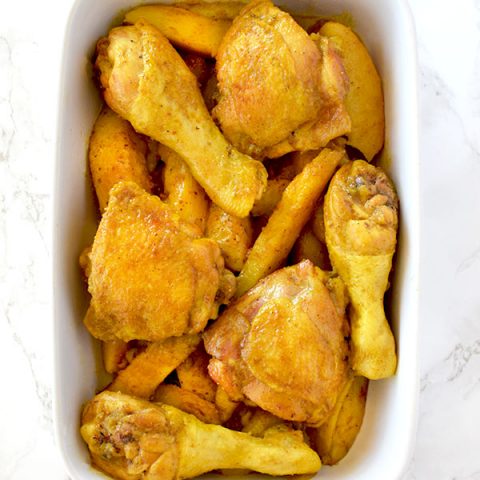
This Israeli chicken brings both flavor and color to any table.
Ingredients
- 2 tablespoons oil
- 4 leg quarters, cut
- 1 large onion, cut
- 2 pounds potatoes, cut long (1 kilogram)
- 1 teaspoon turmeric
- 2 teaspoon hawaij, or more turmeric
- 2 teaspoons chicken bouillon powder
- 1 cup water (235 milliliters)
- Salt
- Pepper
Instructions
- Pat the chicken dry. Coat the pan with oil. When hot, fry the chicken skin side down until golden brown.
- Remove the chicken and set aside. Add onions and mix, scraping up the brown bits from the chicken. Sauté until they begin to brown.
- Add potatoes. Fry on both sides until lightly browned.
- Sprinkle turmeric, hawaij (or more turmeric if you don’t have hawaij), and chicken bouillon powder. Mix.
- Add the chicken, face up. Cook for about a minute.
- Pour water until the chicken is half covered. Add more as needed.
- Bring to a boil. Lower to a simmer. Cook on a low heat for half an hour or until chicken is cooked through and potatoes are soft.
- Add salt and pepper to taste.
Nutrition Information:
Yield:
8Serving Size:
1Amount Per Serving: Calories: 261Total Fat: 15gSaturated Fat: 3gTrans Fat: 0gUnsaturated Fat: 10gCholesterol: 164mgSodium: 213mgCarbohydrates: 26gFiber: 3gSugar: 2gProtein: 34g
Eilidh
Sunday 29th of March 2020
Hey, thanks for sharing your recipes. Hoping to make some this week and reminisce of some holidays in Israel ❤️. Can you do this in the slow cooker? If so how long would you cook it for?
Thanks, Eilidh
ElissaBeth
Sunday 29th of March 2020
Hi :) Honestly the only thing my family ever made in a slow cooker was chollent and even that we haven't done for years... I haven't the foggiest of how to make slow cooker recipes. However, if you figure out how long to cook it for, it would be great for you to post it for other :)