
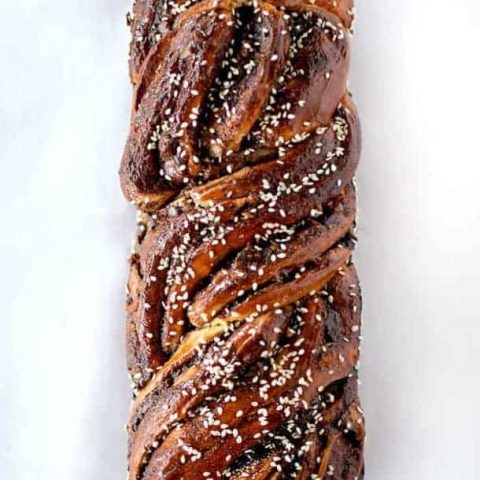
This irresistible chocolate babka is packed with rich chocolate swirls, chopped walnuts, and bursts of chocolate chips. Every slice is soft, chocolaty, and loaded with flavor!
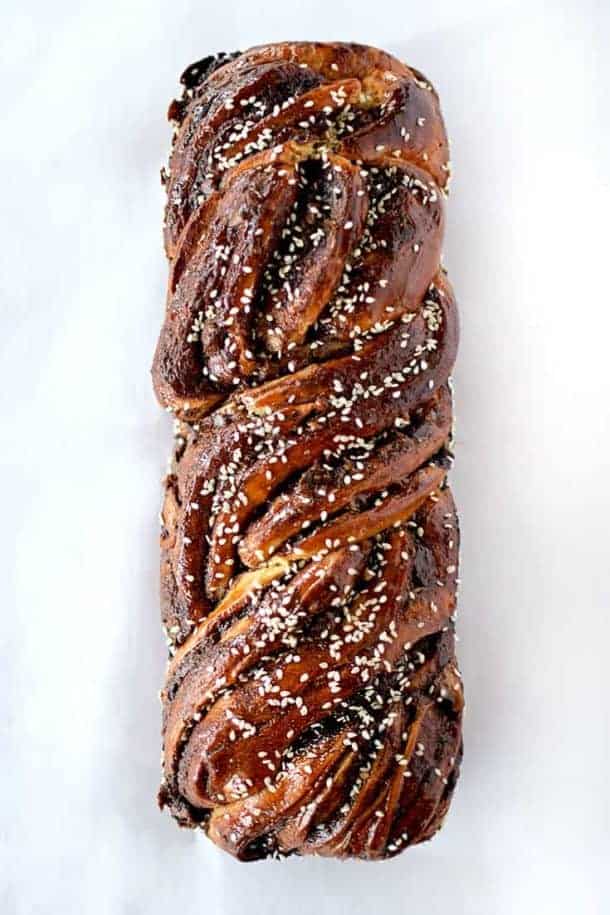
I honestly am in love with this babka!
It's so moist, ultra fluffy, chocolatey, and flavorful!
Originally I trying to mimic the way the bakeries in Israel have it with the air pockets - which I never managed to figure out how to do - but this by far the best homemade babka I've ever tasted!
I also love that it doesn't use a spread (which I never find gives enough flavor) or call for melting chocolate (because who needs the hassle?).
And bonus, it's dairy free.
⭐⭐⭐⭐⭐
"3 years later and this is still my go to recipe for Chocolate Babka! My grandchildren request it and for anyone on a low saturated (dairy free) diet this is a delight! I have taught my girlfriends how to make this Babka with rave reviews! This is a winner!!!"
Julia
Jump to:
- Recipe Development
- Recipe Update
- Variations
- How to Measure Flour and Other Dry Ingredients
- Would bread flour make it even better?
- Can I use whole wheat flour instead?
- Why Does This Recipe Use Oil?
- Why do you use instant yeast?
- Do Eggs Need to Be at Room Temperature?
- Which Type of Cocoa Should I Use?
- What kind of sugar should I use?
- Can I use honey instead of sugar?
- What Kind of Vanilla Should I Use?
- Why do I need to chill the dough?
- What's the best way to proof the dough?
- how can i make my bread rise faster?
- Baking with Humidity
- Adjusting for a Convection Oven
- troubleshooting
- Why did my dough turn out dense and heavy?
- SNAFU
- How to store
- How to freeze
- Other Chocolate Recipes You May like:
- Chocolate Babka
Recipe Development
The first time I tried to make baba at home, I followed one of the popular recipes. At the time all the babka recipes called for called for a chocolate spread.
And it came out terrible!
There was way too much bread and almost no chocolate! And on top of that it came out too dry. I think I ended up throwing it out.
I really wanted to cry.
I know I may take the failed recipes too much to heart, but who wants to feel like a failure after spending all that time and ingredients on something? Especially when they're making it for the family to enjoy?
So yeah, I take bad recipes very personally.
When I decided to try again, I use the filling for my chocolate rugelachs which was great!
And then I used an Israeli dough recipe, which also came out much better.
Later, I took the babka to the next level after noticing that Israeli babkas have bursts of chocolate chips and chopped walnuts. They call it a "crunch."
Recipe Update
I increase the oil in the dough from ⅓ to ½ cup, because I felt it sometimes came out a little dry.
I also increased the filling by another 50% to make it even more chocolatey.
And I added 1.5 teaspoon of vanilla to the filling because after testing it, I felt it really enhanced the flavor.
Variations
Chocolate Chips - adding chocolate chips to the chocolate filling adds to the texture.
Walnuts - adding walnuts adds extra flavor.
Chocolate Chips & Walnuts - best of both worlds.
Sprinkle with Sesame - I used to see this in bakeries in Israel all the time. It didn't really change the flavor but it made it look pretty.
Streusel topping - streusel on top of babka became popular after sesame went out of style.
Chocolate Ganache - topping babka with chocolate ganache is not common in Israel, but it seems to have had a moment in the States. I have seen some in Israel that were topped with ganache and then had mini marshmallows, sprinkles, and cookie pieces - we can go pretty wild with babka here.
How to Measure Flour and Other Dry Ingredients
The best way to measure dry ingredients is with a scale, but in the United States, dry measuring cups are usually used instead.
Weighing ingredients is useful for home bakers, but it's especially important for professional bakers because they work with huge batches.
I usually use dry measuring cups when baking too, because I didn't grow up in a country that generally weighs ingredients, so please don't feel like you can't use them.
To measure most dry ingredients, first spoon them into a dry measuring cup and then level off the measuring cup with an upside-down butter knife.
Make sure not to pack it down because this will cause you to use more of the ingredient than the recipe calls for.
Brown sugar is the exception to the rule, though. To measure brown sugar, pack it into the measuring cup and then level off any excess.
To measure chocolate chips, nuts, or dried fruit, just pour them into the dry measuring cup and then level them off.
What are dry measuring cups?
Dry measuring cups are the set of cups that usually come with measuring spoons. Each cup is a different measurement, just like each spoon is a different measurement.
Liquid measuring cups, on the other hand, are the cups that usually hold more than one cup and have lines on the side that mark the measurements.
The problem with using liquid measuring cups to measure powdery dry ingredients, like flour and cocoa, is that you shake the cup to level them off. This causes the powder to settle, and you end up with more than you need.
I tested this with a friend who didn't believe me, and we ended up with a quarter cup more flour than the recipe called for.
Should I sift the flour and other dry ingredients?
It's usually recommended to sift your powdery ingredients, like flour and cocoa, before using them.
Sifting aerates the flour and removes any lumps, which helps make baked goods fluffier.
It also helps you get a more accurate measurement than when you use flour that's been packed tightly in a bag.
And sifting dry ingredients together, like flour, cocoa, and baking powder, helps make sure they're evenly distributed in the batter. Which honestly, I think is probably overrated, so I personally never bother with it.
Would bread flour make it even better?
No. Bread flour creates a chewy texture and heavier and denser bread like in bagels.
This can be great in recipes like bread bowls, but you want babaka to be light and fluffy like challah bread, so stick with all purpose flour.
Can I use whole wheat flour instead?
I wouldn't recommend it. It will change the flavor of the babka - and in my opinion, not for the better.
Just let the babka be the decadent treat that it is.
Why Does This Recipe Use Oil?
Doughs made with oil are moister and more tender, and stay moist and tender longer than doughs baked with butter.
In fact, some recipes call for both oil and butter, instead of only butter, if they want a lighter and airier texture while still keeping the butter flavor.
Also, kosher desserts tend to be dairy free, especially here in Israel.
It's actually really strange to see a dough made with butter instead of oil in Israel, and I created this babka by experimenting with a number of Israeli babka recipes.
In my opinion, Israeli bakeries make the best babka and I'm doing my best to try to replicate them.
Which Type Of Oil to Use
I don't specify in the recipe which type of oil to use because it's mostly personal preference and I don't want anyone to feel they have to use specifically that type of oil. For the most part, you can use whatever oil you feel most comfortable using.
I use neutral oils like canola oil, safflower oil, and vegetable oil.
You can also use stronger oils like olive oil and coconut oil, but keep in mind that they may change the taste somewhat.
If you're going to use olive oil, use the one labeled pure olive oil because it has the mildest flavor. This should make the flavor a lot less noticeable.
Is It Better to Use Canola Oil or Olive Oil?
Canola oil is relatively cheap and, due to its lack of flavor and high smoke point, is very versatile.
Olive oil, on the other hand, is generally considered a healthier choice.
So, really, it's whatever you prefer.
Why do you use instant yeast?
I like instant yeast because it's really easy to use, it rises quickly, it doesn't come prepackaged into packets that don't match the amounts called for in the recipes, and it's more cost-effective than active dry yeast.
This is my favorite type of yeast to use because it lasts longer than fresh yeast, and you need less of it than active dry yeast. I use it whenever I make dinner rolls or cinnamon rolls.
Can I use active dry yeast?
Yes. You can replace instant yeast with dry yeast at a 1:1 ratio (which means spoon for spoon or the exact same amount).
But, keep in mind, it could take 15 to 20 minutes for the dough to rise to double in size.
And, keep in mind, if your yeast is older than 2015 (which is possible because it lasts ages when you freeze it and if you use it sparingly), you need to activate it before using it.
Around 2015, active dry yeast was reformulated so that you wouldn't need to activate it anymore, so you almost definitely do not need to activate/bloom it first, but double-check the instructions on the package just in case.
Can I use rapid-rise yeast?
Rapid-rise yeast is often specifically marketed toward users of bread machines. It's pretty much just instant yeast with a smaller grain.
The smaller granules allow it to dissolve faster in the dough, allowing it to rise even faster than instant yeast, so keep an eye on it to make sure it doesn't overproof.
Can I use fresh yeast?
Fresh yeast, cake yeast, block yeast, wet yeast, or compressed yeast is found in small, foil-wrapped cubes.
It is far less popular with home bakers because it's highly perishable. However, it is still widely available for commercial use and is still used by home bakers in some countries.
The benefit of using it is that it's easier to measure and has the most leavening power.
If you want to use fresh yeast in this recipe, then for every 1 teaspoon of instant dry yeast, you'd need 17 grams (or 0.6 ounces) of fresh yeast.
Make sure to bloom/activate the yeast before using it in this recipe.
Can I use sourdough starter instead of yeast?
Sourdough starter is wild yeast (which exists in the air) that has been cultivated.
I haven't tested it, so I really wouldn't recommend it. Sourdough is much more finicky to work with.
My brother once made a starter and named it Meekol (as if my family didn't have enough pets between the dog, backyard cats, parrots, and hamsters, we now had a pet made of fermented cultures!).
It was easy enough to make, but when we tried to make sourdough bread from some of it, it totally flopped, and the sourdough bread (if the results could even be called that) was thrown out.
In my opinion it's really too risky to use for this recipe.
Why activate the yeast first?
Even though I use instant yeast, I recommend activating it first if you have concern that it may be old.
This is especially important if you store your yeast outside the freezer, which drastically shortens its life span.
I almost always activate my yeast first, even though I store it in the freezer, because it helps me troubleshoot if something goes wrong.
I've had it happen a few times that the dough in a recipe took a long time to rise, and I was scared that the yeast wasn't good anymore, and I wasn't sure if the dough was hopeless and I should throw it out and start over (if I even had the time to start over), or if I should give it more time.
It always turned out that it just needed more time, but that caused me enough stress that I almost always make sure to proof the dough first just to be sure the yeast is still alive.
And it's particularly useful when you don't have a "warm" place to let it rise, because lower temperatures cause the dough to rise slowly.
And of course, if you're using fresh yeast, you do have to activate it first.
How do I activate yeast?
To activate or bloom the yeast, mix the yeast with warm liquid (usually around 110°F or 43°C) with sugar.
Most recipes call for a small amount of sugar, but I always use all of the sugar and liquid called for in the recipe to save time.
The sugar provides a food source for the yeast. After a few minutes, the mixture should become frothy, telling you that the yeast is active and ready for use.
Sometimes it could take longer, so don't worry if it takes around 10 minutes to be sure.
After that, you can add the rest of the ingredients to make the dough.
Do Eggs Need to Be at Room Temperature?
The short answer is "no."
While a lot of recipes call for room-temperature eggs, the difference is only noticeable if you do a side-by-side comparison, and even then, the difference is very slight.
How Can I Tell if My Eggs Are Still Good?
Fill a glass with cool water and submerge the eggs.
If the eggs sink to the bottom and lay flat on their side, they're still fresh.
If they sink but stand on one end at the bottom of the glass, the eggs are older but still good to use.
If an egg floats to the top, it's very old and should be checked carefully for signs of spoilage before using.
Which Type of Cocoa Should I Use?
When a recipe calls for cocoa, always use unsweetened cocoa powder, unless specified otherwise.
This allows you to have better control of the sweetness of what you're making.
There are three basic forms of unsweetened cocoa powder: natural cocoa powder, Dutch-processed cocoa powder, and raw cacao powder.
Natural cocoa powder is your basic non-specialty cocoa powder, and it's the one you should use natural unsweetened cocoa powder for this recipe.
Natural cocoa powder is the most commonly used type of cocoa powder and is what you should use in most recipes, such as brownies, chocolate cupcakes, hot chocolate, or any recipe that simply says "cocoa powder."
Pro Tip: I store cocoa powder in a large canister so it doesn't make a mess when I go to use it. Doing this has made baking with cocoa so much easier and way less messy!
And, if you want to learn how to always use cocoa rather than melted chocolate in baking, you may like my post on how to substitute chocolate with cocoa powder.
Can I Use Dutch-Processed Cocoa Powder?
Dutch-processed cocoa powder starts with cocoa beans that have been treated with potassium carbonate, which neutralizes their acidity.
Since Dutch-processed cocoa powder is not acidic, it does not react with baking soda the way natural cocoa powder does.
Recipes that rely on natural cocoa powder for the acidity to trigger the baking soda may not rise properly if you replace the natural cocoa with Dutch-processed cocoa.
For this recipe, I recommend sticking with natural cocoa powder, though I have had readers who switched it out and liked the results. So if you want to try it, that's totally up to you.
Can I Use Raw Cacao Powder?
Raw cacao powder is different from natural and Dutch-processed cocoa powders.
It's made from the cacao bean and isn't nearly as processed. It comes from seeds that have been fermented and are processed at low temperatures to ensure that their nutritional benefits and bitter flavor are preserved.
You can use raw cacao powder if you really want to, but I don't recommend it, since it's not as absorbent as cocoa powder, and it may cause the recipe to be too liquidy and not bake properly.
Can I Use Sweetened Cocoa?
Sweetened cocoa is natural cocoa powder mixed with sugar.
Please don't use it when making this recipe because it will make it too sweet.
What kind of sugar should I use?
You should use white granulated sugar, which is also called white sugar, granulated sugar, and table sugar.
If you live in the United Kingdom, you can use caster sugar instead.
You should not use powdered sugar, which is mostly used for dusting desserts and making frosting, icing, and glazes. But it is sometimes used to make fudge.
Can I use honey instead of sugar?
If you'd prefer to use honey instead of sugar, like I do in my honey challah recipe, you can. However, it may change the taste and texture somewhat.
Honey is sweeter than sugar, so you don't need as much of it. As a general rule, use ¾ cup of honey for every 1 cup of sugar.
- 1 cup sugar → ¾ cup honey
- ¾ cup sugar → ⅔ cup honey
- ⅔ cup sugar → ½ cup honey
- ½ cup sugar → 6 tablespoons honey
- ⅓ cup sugar → ¼ cup honey
- ¼ cup sugar → 3 tablespoons honey
Honey also adds liquid to the recipe, so you'll need to reduce the other liquid. For every cup of sugar you replace with honey, reduce the other liquid by about 3 to 4 tablespoons.
- 1 cup honey → remove 3 to 4 tablespoons liquid
- ¾ cup honey → remove about 2¼ to 3 tablespoons liquid
- ½ cup honey → remove about 1½ to 2 tablespoons liquid
- ¼ cup honey → remove about 1 tablespoon liquid
If there isn't enough liquid in the recipe to remove, you can remove it from the egg whites instead, but NEVER remove it from the oil.
Honey also causes baked goods to brown more quickly. For this reason, avoid using honey in recipes that need to be baked at temperatures above 350°F or 175°C.
What Kind of Vanilla Should I Use?
There are several types of vanilla you can use in baking, including vanilla extract, imitation vanilla, vanilla paste, and vanilla beans.
For everyday baked goods like muffins, cakes, cookies, and quick breads, some options are more practical than others.
Vanilla Extract
Vanilla extract is made by soaking vanilla beans in alcohol, which extracts the compounds responsible for their flavor. It is the most common type of vanilla used in baking.
When a recipe-including mine-calls for vanilla extract or simply says "vanilla," this is the type of vanilla that is generally being referred to.
Can I use imitation vanilla?
Imitation vanilla, also called artificial vanilla or vanilla essence, is considerably less expensive than pure vanilla extract and works well in everyday baked goods.
Since vanilla extract can be expensive, you can use imitation vanilla in my recipes without a problem.
Imitation vanilla can be used spoon for spoon in place of pure vanilla extract.
Though, keep in mind that some imitation vanillas are better than others, so if you can, try to use a good one.
Can I use vanilla paste?
Vanilla paste is a thick mixture containing vanilla bean seeds and vanilla extract. Commercial vanilla pastes may also contain sweeteners, thickeners, or other ingredients. It can generally be used in place of vanilla extract and leaves visible flecks of vanilla bean in your baked goods.
Vanilla paste can generally be substituted for vanilla extract spoon for spoon.
Can I use vanilla beans?
Vanilla beans are the pods of vanilla orchids. The seeds inside the pod can be scraped out and added directly to a recipe.
Vanilla beans are more expensive and less convenient than extract, so I wouldn't recommend them for everyday baking.
But if you want to, you can use about 1 teaspoon of vanilla extract for each inch of vanilla bean called for in a recipe.
This is only an approximation, since vanilla beans vary in size and strength.
Can I use vanilla sugar?
Vanilla sugar is sugar that has been flavored with vanilla. It is particularly common in Europe and parts of the Middle East, including Israel.
It can be made by storing vanilla beans in sugar, mixing vanilla bean powder with sugar, or combining sugar with vanilla extract. Some countries also sell vanilla powdered sugar for use in confections.
You can substitute vanilla extract with vanilla sugar spoon for spoon.
How Should I Store Vanilla?
Keep vanilla extract and other vanilla products away from heat and direct light. Store them in an airtight container in a cool, dark place.
Why do I need to chill the dough?
First and foremost, because this dough is supper sticky, so it makes it easier to work with. Also, because it's less likely to rip if you're adding chocolate chips to the filling.
You can chill the dough for just an hour. I like to do this in the freezer rather than the fridge because it gets colder faster that way. But 4 hours in the fridge is better if you have the time.
And, ideally, you'd chill it for 8 to 12 hours in the refrigerator. So, if you put it in the fridge in the evening, leave it overnight, and then take it out in the morning, that would be great.
If you're leaving it to chill for longer than an hour, make sure to wrap it really tightly with plastic wrap. This prevents air from getting to the dough, which not only prevents it from getting crusty, but it also prevents the dough from proofing while in the fridge because the air can't get to it.
You can chill it for up to 24 hours. If you end up chilling it for a little longer, you haven't ruined the dough, but it's preferably that you don't.
What's the best way to proof the dough?
Proofing the dough is letting it rise.
I usually just leave mine out on the counter, but if you want to mimic the way bakeries do it:
Set a large bowl of hot water on the bottom of the oven, place the loaf pans on the middle oven rack, close the oven door, and let the dough rise in the oven for 2 to 3 hours.
Just remember that your babka is in there before preheating the oven!
What is Overproofing Dough?
Letting the dough rise is known as "proofing the dough." Overproofing is when you let the dough rise too much.
If you let your dough rise too much, it will seem big and beautiful at first, and then it will fall and become dense after it's removed from the oven.
If you've found that you left the dough to rise to much larger than double its original size, punch it down, reshape it, and then let it rise to its proper size.
how can i make my bread rise faster?
To speed up the rising process, you can preheat the oven to its lowest temperature and turn it off.
Then, cover the dough with a damp towel and place it in the oven.
This trick works for me every time. On occasion, I may need to remove the dough and preheat the oven another time or two, but usually just once does the trick.
Some bakers feel it doesn't allow flavors to really develop. Personally, I've never noticed much of a difference.
Baking with Humidity
Humidity can have a big impact on how your baked goods come out.
And this babka is especially sensitive to it.
Every time my Mom tries to make this babka recipe in the winter in Israel she complains that the dough is way too wet.
But I've never had any trouble with it, and I tend to bake it in the spring.
This seems to become a problem when humidity is extremely high (think 70 percent or more), baking ingredients like flour soak up moisture from the air.
If this happens to you, you can try what she does, and add a little flour at a time until you get the right consistency.
Adjusting for a Convection Oven
When recipes specify temperatures and cooking times, it's for conventional ovens, unless specified otherwise.
Convection ovens blow the hot air around, producing around 25 to 30 percent more heat.
Since convection ovens produce more heat, you need either lowering the temperature or shortening the cooking time to compensate.
You can also leave the temperature the same and instead, shorten the cooking time by 25%.
However, keep in mind, some convection ovens actually make a heat adjustment for you. That is, if you set a convection oven for 350ºF, it might actually set itself to 325ºF to compensate. So, check your manual before making adjustments.
troubleshooting
While this is a very reliable babka recipe, life happens and sometimes things don't go as planned.
why is it taking longer than expected to bake?
Over time, the thermostat on ovens gets a little off, causing some ovens to run hot and others to run cool. This is why recipes tend to say things like "10 to 15 minutes or until golden brown."
So, if it takes you longer than expected that's fine, don't worry about it. Just keep baking until ready.
why did it Come out dry?
Just like some ovens run cool, others run hot. If your oven runs hot, bake these at a lower temperature. Ideally, you should get an oven thermometer to know what temperature you're really baking at.
Why did my dough turn out dense and heavy?
This can be due to overkneading, not letting it rise completely, overproofing, or using too much flour.
SNAFU
The first time I made this, I didn't give it time to rise to double the size, figuring that one and a half is fine. This was a big mistake!
It made the babka heavier. On the other hand, you don't want to let it rise too long either. When I did this, the moisture starts to accumulate around the bottom and the dough came out dryer.
How to store
Allow to cool completely, then place it inside an airtight container or a resealable plastic bag. Keep at room temperature.
Do not store in the refrigerator. The fridge environment causes it go stale much faster.
How to freeze
Let cool completely. Then wrap the loaf tightly in two layers of plastic wrap and place the inside a freezer-safe bag.
Freeze for up to 3 months. After that, it's still safe to eat but the quality begins to degrade.
If you're in Israel, I recommend making the simple syrup in a finjan. The first time I did this was because I didn't have a small parve pot.
It made pouring the simple syrup very controlled, and the spout made it even more so.
Other Chocolate Recipes You May like:
Or, you may like to try one of my many other dairy free desserts.
Chocolate Babka
This irresistible chocolate babka is packed with rich chocolate swirls, chopped walnuts, and bursts of chocolate chips. Every slice is soft, chocolaty, and loaded with flavor!
Ingredients
Dough
- 1 tablespoon instant yeast
- ½ cup white sugar (100 grams)
- ¾ cup lukewarm water (180 milliliters)
- 2 eggs
- ⅓ cup oil (80 milliliter)
- 1 teaspoon vanilla
- 1 teaspoon salt
- 4 cups all-purpose flour (480 grams)
Filling
- 1½ cup cocoa (130 grams)
- 1 cup sugar (200 grams)
- ⅔ cup oil (160 milliliter)
- 1½ teaspoon vanilla
- 1½ teaspoon cinnamon
- ¼ cup walnuts, chopped, optional (30 grams)
- ⅓ cup chocolate chips, optional (60 grams)
Glaze and Topping
- 1 egg, beaten
- ¼ cup water (60 milliliters)
- ¼ cup sugar (50 grams)
- ½ teaspoon sesame seeds, optional
Instructions
- Combine instant yeast, sugar, and water into the bowl of a stand mixer. Stir and let sit until it begins to froth.
- Add eggs, oil, vanilla, and salt to the bowl. Then add flour.
- Using your bread hook, knead until the dough pulls away from the sides of the bowl. The dough may look dry and shaggy at first, but it will settle in. Once the dough is pulling away from the sides of the bowl it should be extremely sticky but it shouldn't feel wet. If the dough is too wet, add a tablespoon of flour at a time until you get the right consistency.
- Divide the dough in two (I recommend using a kitchen scale for this if you have one), and shape each half into a rectangle. Tightly wrap it in plastic wrap, and chill for 1 to 24 hours. The chilled dough is much easier to work with. See note related to chilling.
- Unwrap one of the blocks of dough and place it on a lightly floured surface. Roll out into a 9x24 rectangle.
- In small mixing bowl combine cocoa, sugar, oil, vanilla, and cinnamon. Poor half of it on the dough and spread it even layer. Make sure to spread it along the edges too. If you have one, an offset spatula is really helpful for this step.
- If desired, sprinkle walnuts and/or chocolate chips evenly across the dough.
- Starting at the shorter end, roll the dough tightly into a log, tugging a little as you go.
- Cut the log straight down the middle.
- Place the halves in an X shape with cut side up. Then twist the pieces around each other. Make sure the cut part with the chocolate filling is always face up.
- Place in a greased or parchment paper lined standard size loaf pan and repeat steps 5 through 11 steps with the second brick of dough.
- Let rise in a warm place until doubled in size. About 1½ to 2 hours.
- Preheat the oven to 350°F or 175°C. Brush babkas with the beaten egg.
- Bake for 30 to 40 minutes or until the top is a beautiful brown color. Remove from oven and set aside.
- Heat ¼ sugar and ¼ water in pot to create simple syrup. Poor half over each babka.
- If desired, generously spoon the syrup over the babka and sprinkle the sesame seeds.
Nutrition Information:
Yield:
14Serving Size:
1Amount Per Serving: Calories: 403Total Fat: 18gSaturated Fat: 2gTrans Fat: 0gUnsaturated Fat: 14gCholesterol: 40mgSodium: 169mgCarbohydrates: 55gFiber: 3gSugar: 23gProtein: 7g

Hi, I'm ElissaBeth!
I created The Taste of Kosher to give you delicious, easy-to-make recipes you can feel proud to serve. I don't believe there are bad cooks and bakers, only bad recipes. I also believe that kosher and allergy-friendly recipes can and should taste just as good as the originals, and it's my mission to prove it.
3 years later and this is still my go to recipe for Chocolate Babka! My grandchildren request it and for anyone on a low saturated (dairy free) diet this is a delight! I have taught my girlfriends how to make this Babka with rave reviews! This is a winner!!! Thank you so much for sharing. With kind regards, Julia.
I am extremely glad to hear that! Thank you for sharing ❤️
I tried this recipe with excitement, but unfortunately it did not work as planned. The dough was extremely thick, dry, lumpy, and the yeast didn’t activate properly. Weirdly enough, it was too sticky to roll out and created a huge mess! I also found the chocolate filling to be very liquidy and therefore hard to spread. I had to struggle to get it in the oven with another friend supporting my arms as it was too dense and heavy. The recipe was a bit confusing to follow, however I haven’t given up hope just yet. It tasted pretty good! I’m hoping to try making it another time and see if I have better results. Any suggestions? Thank you kindly,
Jonah
That sound very strange... especially it being dry and yet sticky... and needing two people to put it in the oven... I'd suggest checking to see that your dry and liquid measuring cups are comparable to each other because when they're not it could really throw measurements off. I'd also pay close attention when I add the flour and add the last cup slowly. Also, I'd activate the yeast before using it if you think it didn't activate properly, just to eliminate that as a possible problem when testing it in the future. I hope that helps 🙂
What a great post. Thank you so much. I have been baking for 35 years and I just learned so much. Thank you!
It's truly my pleasure 🙂
Hi ElissaBeth,
Thank you for this detailed and thoughtful recipe! I was wondering if the cake can be frozen before baking? Alternatively, can it also be frozen after baking?
Thank you!
It potentially can be frozen before baking but that may lead to rising issues later. It defiantly can be frozen after baking without any issues 🙂
Hello, I have made this recipe several times, it is now a family favorite! I was always intimidated with yeast recipes but this is easy to follow, tastes delicious! Thank you ElissaBeth!
You're very welcome! I am so glad to hear that this recipe was easy for you and comes out well 🙂
Hi! I'm about to make this recipe. I see there is an asterisk next to 'oil' in the filling section, but cannot find where it is referenced. Please share!
Thank you!
Hi,
It was leftover from a note that used to expand on types of oil but now it is a part of the post.
@ElissaBeth, Thank You! and thank you for replying to quickly on such a hectic day. Chag Sameach!!
My pleasure 🙂
Do you have suggestions for an apple cinnamon filling (not canned apple pie filling please)?
Sure, to make an apple cinnamon filling, use 4.5 Tablespoons of oil, 1/2 cup brown sugar, 1 1/2 Tablespoons ground cinnamon, and 2 medium apples peeled and chopped apples. Mix it all together and use it instead of the chocolate mixture.
Its very nice. Ive made it twice. Do you have a cinnamon filling recipe to share.?
I've yet to come up with a perfect cinnamon filling but I'm working on it 🙂
Outstanding Babka. I made it exactly what the recipe called it. I will definitely make it again and again.
I'm glad you enjoyed it 🙂
Does this make one or two babkas? My braided log seems too long to fit in one 2 lb loaf tin
It makes one large one or two small ones.
I don’t have a stand mixer. Can I use my food processor ? If I hand knead, how long should I knead it?
I've never made bread dough using a food processor though in theory it should work. By hand it should be kneaded for about 25 minutes.